Summary:
The map is a semi-open world designed for the extraction shooter genre, where you are a mercenary entrusted with searching and retrieving contaminated material from an alien colony.
The player’s objective is to restore power in the settlement by interacting with terminals, unlocking the HQ and finding the boss.
Objective:
Creating an immersive and functional environment for testing level design principles, flow, readability, objective progression and some environment storytelling. Additionally, testing Blueprint programming skills.
Tools:
- Unreal Engine 5.4;
- Tether Plugin (for cables);
- Advanced Locomotion System;
- Gaea Landscape Creator;
Role and Responsibilities:
- Level Design
- Conceptualizing and researching
- Creating Blockouts and Iterating
- Worldbuilding and Quest Design
- Map Partitioning: Architected the conecpt and justification for each map section (compounds), ensuring that each section aligned with the world lore.
- Quest Design: developed challenges that would align with the world building and present a fun and meaningfull challenge to the player.
- Narrative Design: write and contextualize the worldbuilding with previous civilization, and different faction rivalry.
Important Note: This level is still a WIP. Because of this, enemy behaviour and playable areas are limited. A playable build can be found at the following link.
Overview


Video showcase here!
Contextual Worldbuilding (Design-Relevant)
This section outlines the worldbuilding logic that informed spatial hierarchy, architectural language, and player navigation across Alpha Molds. The goal is not to present full narrative arcs or questlines, but to demonstrate how cultural, ecological and faction-based context shaped level-design decisions.
Colonized Frontier
Alpha Molds is set on a recently conquered alien world. The compound layout reflects this early-stage settlement: functional, modular, and visibly layered over what once belonged to another civilization. Selling manking presence for dominance over subtle insersion.
Military Foothold: Modular Expansionism
Human military forces deploy using mass-produced modular structures designed for fast planetary takeover.
Their architecture communicates a culture accustomed to repeated interplanetary incursions.
- Clean silhouettes
- Standardized forms
- Large structural footprints dropped directly onto untouched terrain.
Military buildings exist because this faction prioritizes rapid establishment over environmental integration.

Ecological Suppression and Controlled Atmosphere
Before civilians or researchers arrive, the military performs ecological clearing and atmospheric stabilization. This context justified:
• Barren perimeters
• Absence of alien flora in active zones
• Terrain depressions and scars that inform POI placement
• Open sightlines created deliberately rather than naturally
Environmental storytelling becomes a by-product of the occupation phase, not an aesthetic flourish.
Research Division: Exploratory Architecture
Research facilities arrive with different values and priorities. Where the military expands outward, researchers expand inward through understanding: specialized equipment, field-lab structures, and a more organic architectural treatment.
Their presence justified curved silhouettes and softened geometry, supporting the idea that this faction studies the world rather than overwriting it.

Medical Compounds
Medical facilities appear only after the military has secured the area, marking the shift from conquest to long-term survival. Their architectural language contrasts sharply with the prefabricated military units: instead of imposing modules, these structures rely on terraforming and environmental shaping, resulting in round silhouettes, soft edges and lighter tones. This instantly signals “stabilized space” to the player and helps frame the medical compound as a safe, recuperative zone within the larger occupation sequence.

Factional Tensions Embedded into Space
The three dominant human groups:
- Military: blocks dominate key chokepoints.
- Scientific Expedition: sit at deliberate remove, expressing autonomy.
- Tech-Research: do not share identical goals.
- Civilian presence grows only on stabilized ground, symbolizing dependency.
These relationships informed spawn distribution, player routing and environmental rhythm.
Design Techniques
Teasing and Landmarking
To ensure clear player navigation, some landmarks represented by communication towers were placed above important buildings or compounds, assuring that the player always has a clear goal to follow.

Rationale: The goal was to create generic landmarks that could allow the player to find paths and navigate throughout the map, and theme-based landmarks that would help the player find and identify different map sections for better macro navigation.
Guiding Lines
To further aid player navigation within compounds, electric cables act as visual guides, directing the player's attention towards objectives.


Rationale: Since guidelines can simply be consequence of perspective cables and handrails added to serve the purpose of reinforcing the natural guidance that perspective may create, gently tweak the player flow towards objectives.
Playtesting and Updates
Guide Lines Update
After playtesting and receiving feedback the cables for guidelines were relocated, the problem was that the cables were too high to be perceived. So the solution was simply to put them near the fuze boxes.
This facilitated the perception of guidelines while highlighting main buildings and landmarks. Lowering the standard building's light pools made the main building pools more noticeable.
Trade-Offs: One alternative was to add small artificial lights along the guideline. It didn’t survive testing: terrain verticality created situations where skylight and bloom aligned with those lights, making the guideline even harder to see which contradicted the core purpose of the guidelines, staying readable during fast navigation and varied vertical angles.
Lighting Update
Other recurring issue was that the map was perceived as too dark.
However, increasing global brightness wasn’t an option. The landscape material is snow-white, and any exposure boost would result in harsh overexposure and visual discomfort.
The solution was to shift the color palette rather than the intensity.
I replaced the previous pinkish ambient tint with a cooler blue tone. This change accomplished three goals at once:
- It preserved overall visibility without raising exposure.
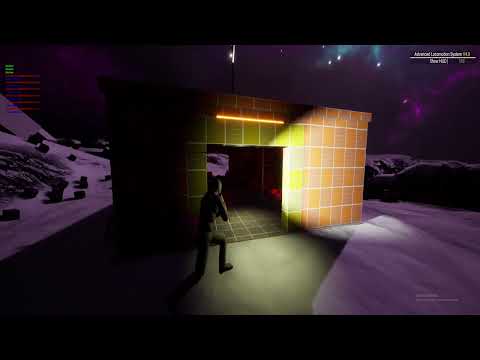
- It improved gameplay readability: the blue background enhanced the contrast of warm colors used for interaction cues. Orange for standard doors and red for locked or objective-related doors became significantly clearer.
- The green emissive used for unlocked doors remained unaffected, since it was already bright and saturated enough to stand out.
The blue tint also reinforced the intended nighttime atmosphere, creating a clearer environmental mood while maintaining gameplay clarity.


Reveal
Some spawn points use “tease” and reveal to gradually show the compound to players.

Rationale: The intent was to create a small awe moment while pacing information: objective position, traversal options, potential threats, and safe fallback/escape lines. A low-to-high reveal allowed that onboarding without sacrificing readability or safety.
Trade-Offs: An alternative was to place spawn points on elevated ground for a full top-down reveal. It was discarded due to:
- Information overload — too much of the compound visible at once.
- Poor survivability — elevation made it difficult to offer cohesive and fair cover.
Lowering the starting position kept the reveal controlled and allowed the terrain to naturally gate information.
Pre-Production
Flow and Pathing
Before beginning the level blockout, I first define where the main locations and compounds should be. After that, I create the major structure rotations and locations to ensure that the player can navigate smoothly throughout the level and keep the movement flowing.
Each color represents a location type, green are military builds and militarized locations, blue represents civil buildings while ping represents fauna and flora. Red will focus on reseach and science buildings, they were next to the only yellow area that sinbolizes the alien species that once lived there.


Rationale: This flowchart was created aiming that each section would have secondary, less dangerous zones while having a core area, all of which would serve the same objective of giving the player objective information, but the main (represented by the number 1) would give a more precise reward and better loot.
Military Zone Pathing and Clash Points
Understanding the open-world aspect of the level, the player's pathing is not solid and repetitive. Allowing the player to create new paths, “pixels”, power picks, and other strategies is crucial to the map’s longevity and replayability.
Even if the level is not linear, the player’s possible behaviour can be predicted, and with those predicaments, the proper combat space and cover placement can be allocated. A few players’ possible flows can be found below.
Even if the level is not linear, the player’s possible behaviour can be predicted, and with those predicaments, the proper combat space and cover placement can be allocated. A few players’ possible flows can be found below.


Knowing the player pattern makes it possible to predict and enhance encounters and clash points by positioning minor objectives and loot.
The image on the right showcases the possible encounters (question mark) and highlights clash points with the X. Those points are created by the most probable repetitive interest point independent of the spawn or route taken by the player, and the main objective that will draw player attention because of its existence.
Rationale: Pathing was defined after the initial blockout. Once the topography and spawn positions were in place, the natural player routes emerged. Those routes were then reinforced through micro-adjustments and spawn repositioning.

Pacing
Another map aspect that is influenced by the multiplayer is “pacing”, Although each spawn point allows players to explore and engage with objectives via different routes, the pacing should remain consistent for all teams.
Personally is easier to understand level pacing in a timeline that can be broken down into three timestamps:
- Minor Objectives: A low-tension exploration or PVE encounters timestamp, is used to make the player warm up to the game and locate himself and his objectives using landmarks, some soft gates ensure that the player takes some time to explore before rushing combat encounters.
- Combat Encounters: High-tension encounters with other players or major PVEs challenges with special mutation
- Region Goal: After a Soft Gate that is used to lower the combat tension, a new combat will happen to start again the tension cycle.


Working together with pacing and pathing those timestamps ensures that players have a good pacing and tension cycles while leaving time to breathe and re-organize inventory, complete side quest and plan the next steps.
The image below represents where the timestamps take place and where the “breathing zones” are placed (normally between compounds)
Landscape & Heighmap
Using a software called Gaea to create the landscape was a very important choice, it helped me to create a high-quality landscape with textures which helped me to create a placeholder material.
These characteristics helped me to adapt the player flow and landmark locations to a closer final version of the terrain, which improved a lot of production time.

References and Mood Board

After drawing the map, I researched references to help me during the blockout phase. This meant having mood boards and watching sci-fi movies and videos from games that I would inspire myself. The idea was to create the most believable area possible, assuring that the player would feel immersed while having fun.
 Made with Bullet